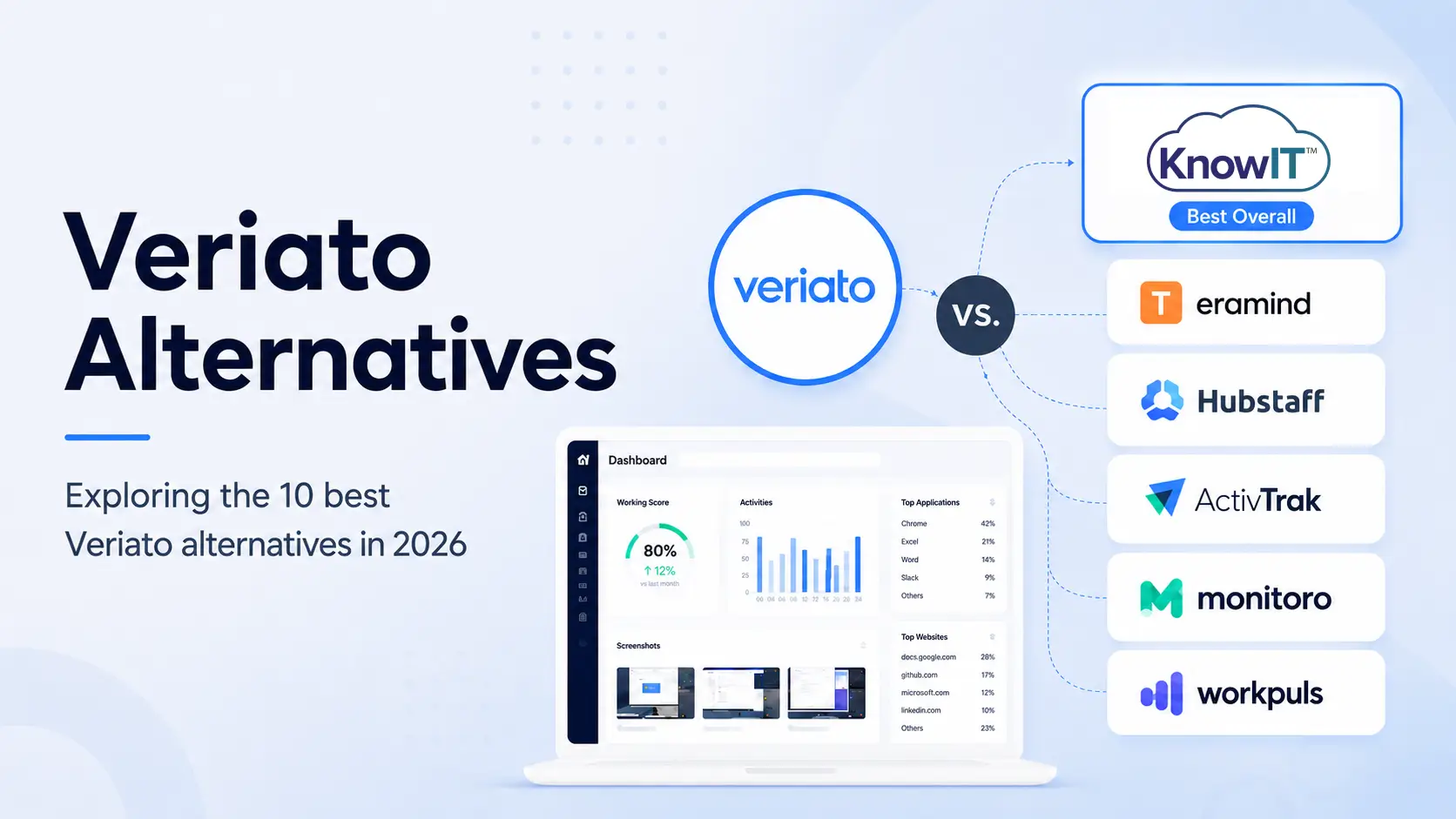
Executive summary
Veriato is a capable platform for user activity monitoring and insider-risk analysis, but it is not the best fit for every business.
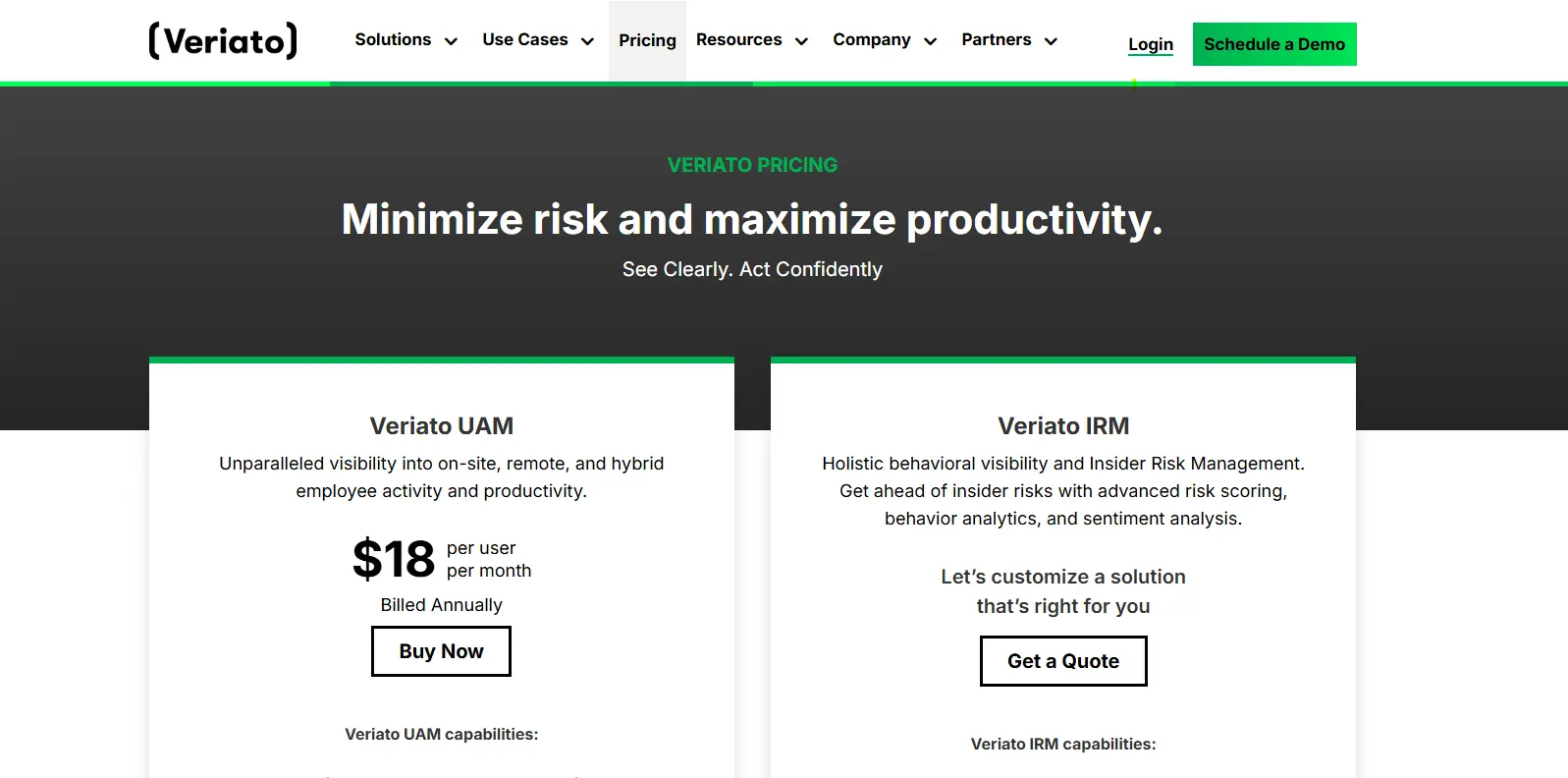
Veriato User Activity Monitoring (UAM) starts at $18 per user per month, is billed annually and requires at least five users. Veriato Insider Risk Management (IRM) requires at least 20 users and uses quote-based pricing. And neither of their products offer a free trial.
That buying model can be unnecessarily restrictive for a smaller company, a team that wants to begin with one device, or an organization that wants to test a solution before making a long-term commitment.
Besides this, Veriato’s DLP feature set does not block file transfers, so it cannot be considered a true DLP solution.
⚡ TL;DR — Quick Summary
KnowIT is our number-one Veriato alternative for small and medium-sized businesses. It has no minimum purchase for paid editions, offers monthly billing, provides a 10% annual-payment discount, and lets new customers try the Complete edition for 14 days. If they do not upgrade, they can continue with a genuinely free edition for up to five Windows, macOS or Android devices.
KnowIT is also the stronger option when the requirement is to stop a file from leaving, not simply record the event and alert an administrator.
On Windows, KnowIT can block transfers through USB, web uploads and network storage, restrict peripheral devices, and limit application access to specified file types.
Its Android coverage is another important difference, with phone and VoIP call recording, broader IM coverage, browser and network activity, location, contacts, calendars, notes and mobile-device controls.
Veriato still has meaningful advantages. IRM offers sophisticated user and group risk scoring, behavior baselining, anomaly detection, sentiment analysis and automatic PII/PHI identification and redaction. Its Microsoft 365 integration and ChromeOS support may also make it the better choice for some large or regulated organizations.
The right choice therefore depends on the problem you are solving. Choose KnowIT when you want a transparent, self-service route into employee monitoring and DLP, particularly across computers and Android devices. Choose Veriato IRM or another enterprise platform when behavioral analytics, sensitive-data classification or large-scale security operations matter more than cost and purchasing flexibility.
Why businesses search for Veriato alternatives
Before answering this question, let’s understand the products Veriato sell
- Veriato User Activity Monitoring (UAM) records activity such as websites, applications, email, chat, screenshots, login and logoff times, files, network connections and keystrokes. It also includes productivity scoring, dashboards, reports, alerts, recording policies, sensitive-data detection and redaction, Microsoft 365 integration and an API.
- Veriato Insider Risk Management (IRM) includes UAM and adds user and group risk scoring, behavior baselines, anomaly detection, language and sentiment analysis, and a dedicated risk-management dashboard.
The best alternatives to Veriato are therefore not all trying to solve the same problem. Businesses commonly look elsewhere for five reasons.
1. A lower cost of entry
Veriato publishes UAM at $18 per user per month, billed annually, with a five-user minimum. The smallest published purchase is therefore $1,080 for one year, even if the business only needs to cover one or two people. IRM has a 20-user minimum and no published price.
KnowIT approaches the same buying decision differently. A company can begin with one paid license, pay month to month, or use the free edition on up to five devices. For businesses that are not ready to standardize across a whole department, the difference between “one device today” and “five users for a year” is more important than a small difference in the headline per-user rate.
2. A clearer way to evaluate the product
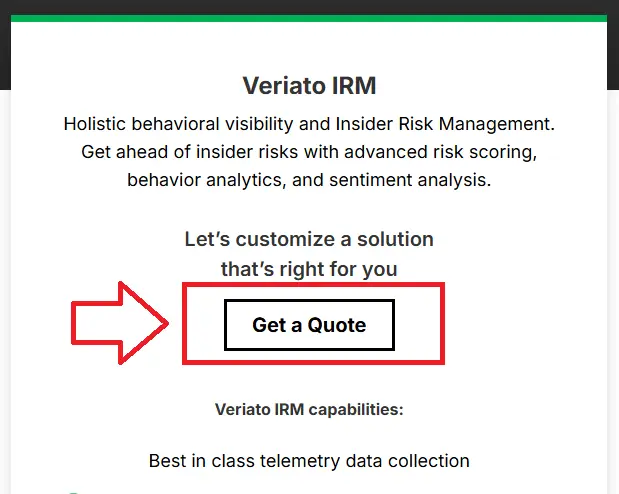
The current Veriato UAM signup process funnels interested users through a call with a sales team. For IRM, you have to “Get a Quote”.
KnowIT on the other hand gives new accounts 14 days of the Complete edition without requiring a credit card. If the customer does not buy, the account automatically moves to the Free edition instead of becoming unusable. That makes evaluation low risk: test the advanced features, keep the essential features, and upgrade only when there is a business case.
3. Prevention rather than observation
“DLP” can mean very different things. One product may identify sensitive information, log a transfer and send an alert. Another may prevent the transfer from completing.
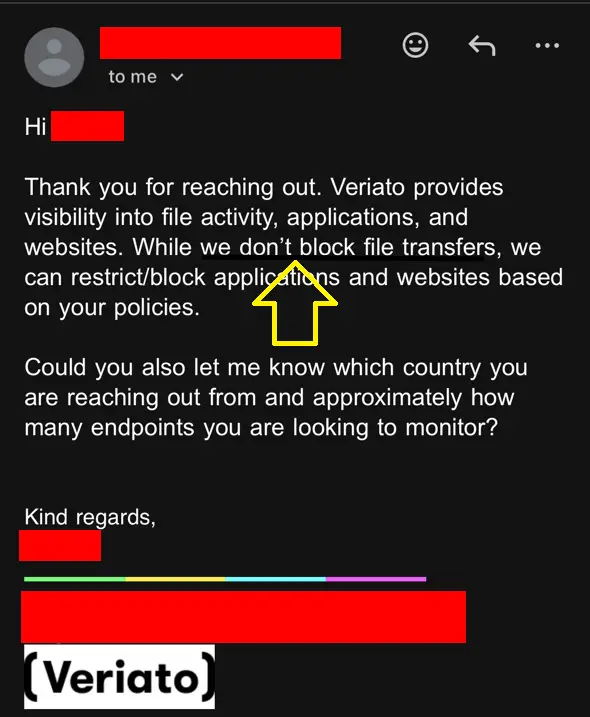
Veriato’s features off file and document telemetry, transfer alerts, anomaly detection, and sensitive-data identification and redaction. However, they explicitly do not offer blocking of file transfers through USB, web uploads or network storage.
KnowIT does offer file-transfer blocking on Windows. Administrators can block USB, web and network-storage transfers, restrict peripherals, and prevent specified applications from accessing selected file types. If the objective is “this file must not leave,” that enforcement layer is a major differentiator.
4. Better coverage of company-owned Android phones
Veriato supports Android and can record useful activity, including app usage, calls, SMS/MMS, selected incoming messages, files, screenshots and location. KnowIT goes further for businesses that issue Android phones. KnowIT offers native phone and VoIP call recording, broader IM monitoring, browsing and network-connection history, contacts, calendars, notes, media and remote security controls. KnowIT’s mobile call-recording also covers native calls and services such as WhatsApp, LINE and Viber, subject to device and configuration requirements.
5. Less enterprise overhead
Veriato’s strengths—behavior baselines, risk scores, sentiment analysis, SSO, MFA, action auditing and Microsoft 365 integration—are valuable when a security team will actively use them. They can be unnecessary if the buyer simply wants to understand employee activity, control risky transfers and produce practical reports.
The best value is not the platform with the longest feature list. It is the one whose controls match the risks the organization can realistically manage.
The best Veriato alternatives at a glance
| Rank | Alternative | Best for | Free route | DLP or blocking | Main trade-off |
| 1 | KnowIT | SMBs needing monitoring, DLP and strong Android coverage | Free edition for up to 5 devices; 14-day Complete trial | Blocks USB, web and network-storage transfers on Windows | No user-behavior baselining or sentiment-based risk scoring |
| 2 | Teramind | Enterprise UAM, DLP and behavior analytics | Free trial and live demo | Advanced content-aware DLP and automatic blocking | More complex and usually more than a small team needs |
| 3 | ActivTrak | Privacy-conscious workforce analytics | Free plan for up to 3 users | Website blocking, but not full DLP | Less suitable for investigations and data-exfiltration control |
| 4 | WorkTime | Non-invasive productivity and attendance analytics | Free plan for up to 3 employees; 14-day trial | No traditional DLP | Deliberately avoids screenshots, message capture and keystroke content |
| 5 | CurrentWare | Windows-focused web filtering, USB control and DLP | 14-day trial | Blocks devices, file transfers, uploads/downloads and applications | No comparable Android monitoring; modular pricing can add up |
| Rank | Alternative | Best for | Free route | DLP or blocking | Main trade-off |
| 6 | InterGuard | Detailed investigations and evidence collection | 7-day trial and test drive | DLP and policy enforcement | Interface and product experience may feel less modern |
| 7 | Hubstaff | Field teams, GPS, timesheets and payroll workflows | 14-day trial | No full DLP | A productivity/time platform, not a close IRM replacement |
| 8 | Time Doctor | BPOs, agencies and outsourced teams | 14-day trial | No full DLP | Designed for performance measurement rather than insider-risk control |
| 9 | Insightful | Hybrid workforce analytics and automatic time tracking | Free trial | No full DLP | Limited fit for security investigations or mobile-device oversight |
| 10 | Clockify | Free time tracking for projects and billing | Free plan for unlimited users | No | Does not record the detailed endpoint activity expected from Veriato |
1. KnowIT: best overall Veriato alternative for SMBs
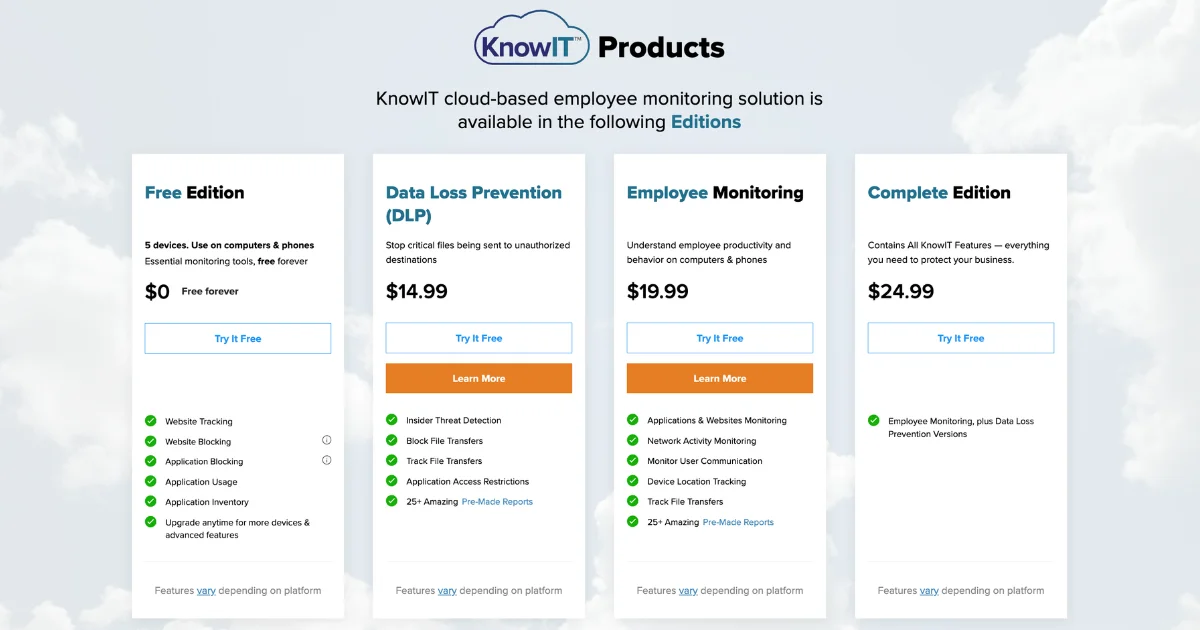
KnowIT ranks first because it addresses the reasons many smaller organizations search for Veriato alternatives in the first place: minimum license commitments, annual lock-in, an unclear evaluation path, limited transfer prevention and shallow mobile comparisons.
It is not a clone of Veriato IRM. KnowIT does not currently provide individual or group behavior baselines, GenAI risk scores, sentiment analysis or automatic PII/PHI redaction. A large security operations team seeking those exact capabilities should keep Veriato IRM or Teramind on its shortlist.
For a small or medium-sized business, however, KnowIT offers a more practical combination of monitoring, prevention, mobile visibility and buying flexibility.
KnowIT vs Veriato feature comparison
The tables below compare Veriato IRM with KnowIT Complete, the closest match in overall package breadth. A check mark means the capability is documented, “Partial” means support is narrower or qualified, and a dash means the capability is not publicly documented for that product.
Employee monitoring
| Feature | Veriato IRM | KnowIT Complete |
| Applications, websites and browsers | ✓ | ✓ |
| Installed-application inventory | — Full desktop inventory not publicly documented | ✓ |
| Email and chat/IM monitoring | ✓ | ✓ |
| Screenshots | ✓ Continuous and trigger-based | ✓ Interval, on-demand and per-app |
| VoIP recording and logs | — | ✓ |
Both products cover the main computer-monitoring requirements. KnowIT stands out for application inventory and VoIP evidence, while Veriato provides more sophisticated screenshot triggers.
Data loss prevention
| Feature | Veriato IRM | KnowIT Complete |
| File activity and transfer monitoring | ✓ | ✓ |
| File-transfer alerts | ✓ | ✓ |
| USB transfer blocking | — | ✓ Windows |
| Web and network-storage transfer blocking | — | ✓ Windows |
| App and file-type access blocking | — | ✓ Windows |
| Sensitive-data detection and redaction | ✓ | — |
This is the most important difference for a prevention-focused buyer. Veriato is stronger at identifying and redacting sensitive content; KnowIT is stronger when the policy must stop specified transfers from completing.
Android monitoring
| Feature | Veriato IRM | KnowIT Complete |
| Call history and location | ✓ | ✓ |
| Phone-call recording | — | ✓ |
| IM monitoring | Partial: selected incoming messages | ✓ Broader app coverage |
| Web-browser tracking | — | ✓ |
| Network-connection history | — | ✓ |
| Contacts, calendars, notes and device controls | — | ✓ |
Veriato provides useful Android activity records, but KnowIT offers substantially deeper coverage for company-owned phones, particularly when communication evidence and device administration matter.
Insider risk and enterprise administration
| Feature | Veriato IRM | KnowIT Complete |
| User and group risk scoring | ✓ | — |
| Behavior baselining and anomaly detection | ✓ | Partial: network anomalies |
| Language and sentiment analysis | ✓ | — |
| Microsoft 365 integration | ✓ | — |
| Automatic PII/PHI identification | ✓ | — |
| SSO, MFA and administrator action audit | ✓ | — |
Veriato IRM is the stronger product for a security team that needs behavior-led risk prioritization, Microsoft 365 visibility and enterprise identity controls. KnowIT’s advantage is practical monitoring and enforcement without the same procurement threshold or operational overhead.
Pricing that works for a one-device start
KnowIT’s paid editions have no minimum license count:
- Data Loss Prevention: $14.99 per device per month
- Employee Monitoring: $19.99 per device per month
- Complete: $24.99 per device per month
- Annual billing: 10% discount
This means a company can begin with one Employee Monitoring license for $19.99 for a month. By comparison, Veriato’s smallest published UAM order is five users for a full year, or $1,080.
The comparison becomes especially clear at five seats. Five KnowIT Employee Monitoring licenses paid annually cost approximately $1,079.46 after the 10% discount. Five Veriato UAM licenses cost $1,080 annually. The totals are nearly identical, but KnowIT does not require the buyer to start at five or commit for a year.
KnowIT Complete costs more per device because it combines monitoring with transfer-blocking controls. That is why “KnowIT is cheaper” should be understood as a lower entry cost and a more flexible commitment—not a claim that every KnowIT edition is always cheaper than every Veriato package in every seat configuration.
A free Veriato alternative that still monitors real activity
KnowIT Free Edition supports up to five Windows, macOS or Android devices. It includes installed-application inventory, application usage history, installation and uninstallation history, browser activity, website blocking, and application blocking where supported.
That is more relevant to “free Veriato alternatives” than a basic timer. A timer can tell you how many hours somebody submitted. KnowIT Free can show which applications are installed, which ones are used, and which websites are visited. It can therefore serve as a useful starting point for asset visibility, software-license review, distraction control and basic policy enforcement.
New accounts begin with the Complete edition for 14 days. No credit card is required on the current Free Edition signup path. If the company chooses not to subscribe, the account automatically downgrades to Free rather than shutting down.
Stronger file-transfer prevention
KnowIT’s DLP features do more than preserve an audit trail. On Windows, administrators can:
- Block transfers through USB storage
- Block web uploads and downloads according to policy
- Block transfers involving network storage
- Restrict unapproved peripheral devices
- Limit specified applications from accessing protected file types
- Track file creation, copying, deletion, renaming, moving and other activity
- Alert on transfers, file changes and suspicious patterns
The practical difference is simple. Monitoring answers, “Who copied the client database, and where did it go?” Prevention aims to stop the copy before it leaves. KnowIT’s DLP overview positions transfer blocking as a core feature rather than an investigation-only capability.
More useful Android monitoring
KnowIT is particularly compelling when company activity occurs on both computers and Android phones. In addition to applications, location and call history, KnowIT can provide phone and supported VoIP call recordings, IM and message records, browser activity, network connections, contacts, calendars, notes and device-management commands.
This can reduce the need for separate employee-monitoring, mobile-device-management and mobile call-recording tools. It also closes an evidentiary gap for businesses whose sales, support or field teams communicate primarily through mobile apps.
Best for: Small and medium-sized businesses that want to start with one device, evaluate the product without a procurement process, combine monitoring with enforceable DLP, or cover Android phones in greater depth.Choose Veriato instead when: User and group risk scoring, behavior baselines, sentiment analysis, Microsoft 365 integration, sensitive-data redaction, ChromeOS or enterprise identity controls are non-negotiable.
2. Teramind: best for advanced enterprise DLP
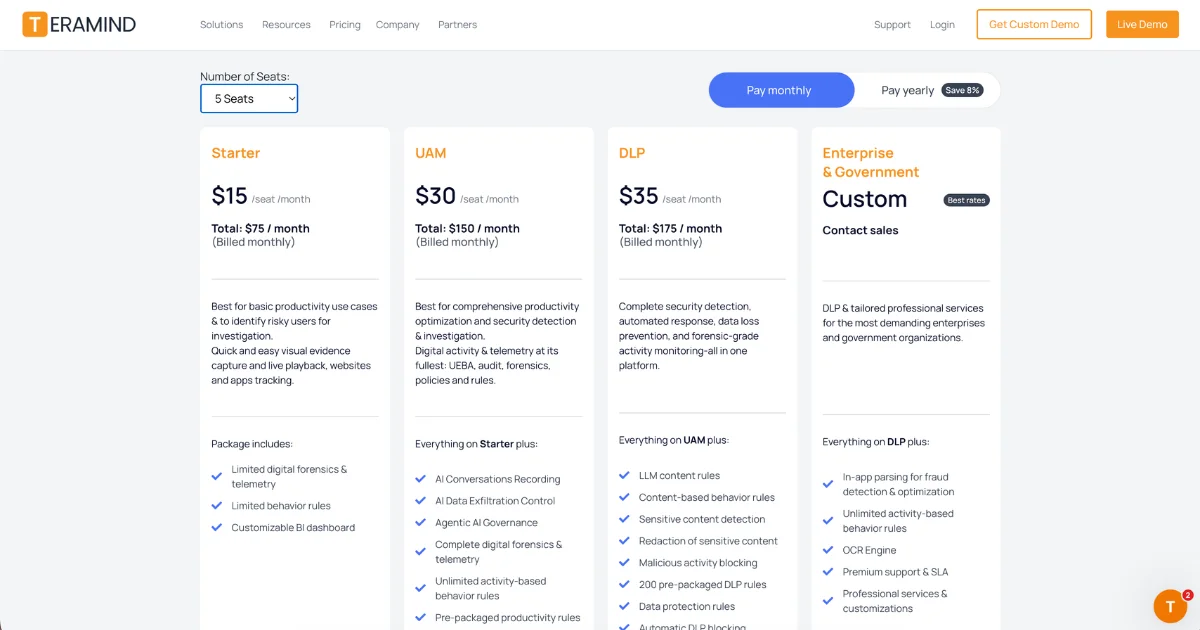
Teramind is one of the closest alternatives to Veriato for organizations that need both deep user activity monitoring and mature data loss prevention. Its product range covers screen recording and live view, web and application activity, email, file transfers, instant messaging, keystrokes, searches, printing, geolocation and time tracking.
The differentiator is policy enforcement. Teramind’s DLP package includes content-based and file-operation rules, sensitive-content detection, redaction, predefined classifications, fingerprinting and automatic blocking. Its UAM and higher packages also provide anomaly detection, risk scoring and behavior rules, making it a credible replacement when the buyer values Veriato IRM’s security orientation.
Teramind offers a free trial and a live demonstration. Its current pricing page uses an interactive seat calculator rather than showing a simple static rate in the page text, so buyers should calculate the total for their deployment and confirm minimums and hosting requirements directly.
The trade-off is complexity. A small company that primarily needs application, web, attendance and file-transfer controls may pay for a governance and forensic toolkit it will not fully use. Teramind is strongest when security teams are prepared to design policies, tune alerts and investigate incidents.
Best for: Mid-market and enterprise security teams that want a Veriato-like monitoring depth plus stronger content-aware DLP enforcement.
Why it ranks below KnowIT: It is a powerful enterprise alternative, but it does not match KnowIT’s unusually low-friction route from a five-device free edition to one-license monthly purchasing and deep Android communications coverage.
3. ActivTrak: best for workforce analytics

ActivTrak is a better Veriato alternative when the business question is “How is work happening?” rather than “Which employee might become an insider threat?” It emphasizes workforce patterns, productivity, workload balance, schedule adherence, technology usage and coaching opportunities.
Its 2026 package structure includes a Free tier for up to three users with 30 days of history, an activity dashboard, website and application usage, productivity trends, weekly digests, role-based access controls and website blocking. Paid packages add real-time visibility, schedule adherence, workload analysis, coaching features, location-aware reporting and AI-assisted insights.
ActivTrak is less invasive than traditional forensic monitoring platforms. That can make adoption easier in organizations concerned about employee trust, but it also means the tool is not designed to replace every Veriato investigation or DLP use case. It does not provide KnowIT’s Windows file-transfer blocking or Veriato IRM’s full behavior-risk and sentiment framework.
Best for: HR, operations and leadership teams that want privacy-conscious productivity analytics, capacity planning and coaching data.
Not ideal for: Businesses that need communication recording, detailed endpoint forensics, Android monitoring or enforceable DLP.
4. WorkTime: best non-invasive Veriato alternative
WorkTime deliberately avoids the most intrusive forms of employee monitoring. Instead of collecting screenshots, message content and detailed keystrokes, it focuses on attendance, active and idle time, application and website use, productivity classification, schedules and workforce trends.
That positioning makes WorkTime a strong option for organizations whose primary goal is improving performance while minimizing the amount of employee content they collect. Its pricing page offers a free plan, while the company’s current Veriato comparison states that the free tier supports up to three employees and that a 14-day trial is available without a credit card.
WorkTime should not be selected as a security-equivalent replacement for Veriato IRM. It does not aim to provide forensic screen evidence, communication capture, content-aware DLP or mobile call recording. Its value lies in collecting less, reducing privacy exposure and giving managers the data required for attendance and productivity conversations.
Best for: Companies that want employee productivity and attendance reporting without capturing the content of screens or communications.
Not ideal for: Insider-risk investigations, file-transfer prevention, legal evidence collection or detailed mobile oversight.
5. CurrentWare: best for Windows web filtering and device control
CurrentWare combines four modules: BrowseReporter for web and application monitoring, BrowseControl for website and application blocking, AccessPatrol for removable-device control and DLP, and enPowerManager for logon and computer power management.
Its current product page advertises a 14-day trial without a credit card, individual modules starting at $12 per license per month, and the full suite at $20 per user per month. AccessPatrol can block USB devices, network storage and other peripherals, alert on transfer activity, and block transfers by filename or file type. BrowseControl adds website, upload/download and Windows application restrictions.
CurrentWare is therefore a credible alternative when a buyer’s main concern is controlling Windows endpoints, removable media and web access. It is less attractive when the workforce relies heavily on Android phones or when the security team wants Veriato IRM-style sentiment analysis and behavioral risk scores.
Best for: Windows-centric organizations that want modular web filtering, application control, USB restrictions and file-transfer policies.
Why KnowIT may fit better: KnowIT combines computer monitoring, DLP and detailed Android coverage in one account, and its DLP-only starting price is lower than CurrentWare’s current full-suite price.
6. InterGuard: best for detailed employee investigations
InterGuard has long focused on evidence collection. It records screenshots, websites, searches, email, chat, application usage, keystrokes, file activity, active and idle time, printing and location information. Its investigation workflow links alerts and anomalous behavior to the underlying activity, helping administrators reconstruct what happened.
InterGuard also offers web filtering and data-loss controls, making it closer to Veriato than a simple productivity tracker. InterGuard’s investigation page documents keyword-triggered and continuous screenshots, 60-plus reports, user-behavior alerts and coverage across PC, Mac, Chromebook and Android. A seven-day trial and online test drive are available.
The principal consideration is product experience. Buyers should test the administrative workflow carefully and compare policy setup, reporting and deployment against newer cloud-native platforms. A strong forensic feature list is only useful if managers can retrieve and interpret the evidence efficiently.
Best for: HR, legal and security teams that prioritize detailed records for investigations and policy enforcement.
Not ideal for: Buyers seeking the simplest self-service experience, a permanent free edition or KnowIT-level Android communication recording.
7. Hubstaff: best for GPS, field teams and payroll workflows
Hubstaff is primarily a time-tracking and workforce-operations platform. It connects tracked hours with timesheets, projects, budgets, invoicing, payroll and productivity signals. Optional screenshots and application/URL activity provide more visibility than a basic timer, while GPS and geofencing make it useful for mobile and field teams.
Hubstaff offers a 14-day trial without a credit card, supports monthly and annual subscriptions, and connects with popular project, payment and accounting systems. It is a logical Veriato alternative when the original requirement has more to do with accurate hours, field attendance, job costing and payroll than insider threats.
It is not a DLP or forensic security platform. Hubstaff does not offer KnowIT’s file-transfer blocking or Veriato IRM’s behavior-risk engine. Buyers should therefore avoid comparing it to Veriato solely because both products can show application activity or screenshots.
Best for: Agencies, construction companies, service businesses and distributed teams that need GPS, geofences, time tracking, project costs and payroll integration.
Not ideal for: Data-exfiltration prevention, communication monitoring or insider-risk investigations.
8. Time Doctor: best for BPO and outsourced teams
Time Doctor is designed to connect employee time with productivity and profitability. Its plans include automatic and manual tracking, projects, screenshots, web and application usage, attendance, schedules, leave, payroll and productivity ratings. Higher tiers add unusual-activity reporting, screen recording, executive dashboards, SSO, APIs and longer data history.
Time Doctor’s current pricing page offers a 14-day trial without a credit card and both monthly and annual billing. Annual customers receive two months free. These terms are attractive to a BPO or agency that wants to test monitoring before rolling it out across client teams.
Time Doctor is a narrower alternative than KnowIT or Teramind. It can help identify inefficient workflows, inaccurate hours and suspicious activity patterns, but it is not positioned as a full DLP platform. It also does not provide the same endpoint and mobile communication evidence as KnowIT.
Best for: BPOs, agencies, remote teams and outsourced operations that care about attendance, hours, screenshots, productivity and payroll.
Not ideal for: File-transfer enforcement, mobile call recording or advanced insider-risk analytics.
9. Insightful: best for hybrid workforce management
Insightful, formerly Workpuls, combines automatic time tracking with application and website analytics, real-time visibility, productivity classification, project tracking and workforce insights. Its dashboard is designed for managers who need to understand where time goes across office, remote and hybrid teams without operating a full security-investigation platform.
The company offers a free trial and several paid packages on its current pricing page. Buyers should compare the plans carefully because features such as advanced reporting, integrations and enterprise controls can vary by tier.
Insightful is most relevant when Veriato feels too security-heavy. It can answer productivity and resource-allocation questions with a cleaner workforce-management focus. It is not a close alternative for content-aware DLP, detailed message monitoring, phone call recording or Veriato IRM’s sentiment-based risk analysis.
Best for: Hybrid organizations that want automatic time, productivity and project visibility in an approachable dashboard.
Not ideal for: Security teams that need preventive DLP or extensive forensic evidence.
10. Clockify: best free option for time tracking only
Clockify deserves a place on a “free Veriato alternatives” list only with a prominent qualification: it is free time-tracking software, not free user activity monitoring.
The free plan supports unlimited users and core time tracking. Teams can record hours against clients, projects and tasks, create timesheets and produce reports. This is useful for freelancers, agencies and businesses that want billing accountability without endpoint surveillance.
Clockify does not provide the Veriato capabilities that lead many buyers to this search: it does not continuously record websites and applications in the same way, build insider-risk profiles, capture communication content, block file transfers or create forensic timelines of endpoint behavior.
Best for: Organizations whose real need is free project time tracking and timesheets.
Not ideal for: Anyone seeking a true replacement for Veriato UAM or IRM.
What is the best free Veriato alternative?
KnowIT is the strongest free Veriato alternative for a small business that wants actual device and activity visibility rather than a manual timer. Its permanent Free edition supports up to five devices and covers application inventory, application usage, installation history, web activity and selected blocking controls.
ActivTrak and WorkTime are also credible free options for up to three users, particularly when productivity analytics and lower-intrusion monitoring are the priority. Clockify is the best zero-cost choice for unlimited-user time tracking, but it should not be described as an equivalent employee-monitoring or insider-risk product.
The choice can be simplified as follows:
- Choose KnowIT Free for basic monitoring and application/website controls across up to five computers or Android devices.
- Choose ActivTrak Free for productivity trends and activity analytics across up to three users.
- Choose WorkTime Free for non-invasive attendance and productivity monitoring across a very small team.
- Choose Clockify Free when employees will record time themselves and endpoint monitoring is unnecessary.
KnowIT vs Veriato: the decision in plain English
Choose KnowIT if you want to start small, pay monthly, try the full product before buying, retain a useful free edition, block risky file transfers, and monitor company-owned Android phones in greater depth.
Choose Veriato UAM if you have at least five users, are comfortable with annual billing, and particularly value Microsoft 365 integration, sensitive-data detection/redaction, keyword- or activity-triggered screenshots, ChromeOS support and enterprise administration.
Choose Veriato IRM if you have at least 20 users and need behavior baselines, individual and group risk scoring, anomaly detection, language and sentiment analysis, SSO/MFA, action auditing and a security-team workflow built around prioritizing risky users.
Choose Teramind if you want a close enterprise competitor to Veriato with more explicit, content-aware DLP blocking.
Choose ActivTrak, WorkTime, Hubstaff, Time Doctor or Insightful if your true requirement is workforce productivity, attendance, capacity, billing or field-team management rather than insider-risk prevention.
How to evaluate an alternative before you buy
Marketing comparison tables rarely expose the details that determine whether a deployment succeeds. Before choosing any alternative, run a small proof of concept and ask the following questions.
Can it enforce the policy or only report a violation?
Ask the vendor to demonstrate a prohibited USB copy, web upload and network-storage transfer. Confirm whether the action is blocked, whether the user sees a warning, what event is logged and how quickly the administrator is alerted.
What exactly is supported on each operating system?
“Windows, Mac and Android” does not mean identical features on all three. Request a platform-by-platform matrix. Check browser coverage, screenshots, file controls, messages, call recording, location, MDM commands and any rooting or permission requirements.
What is the smallest real commitment?
Calculate the total first invoice, not merely the advertised monthly equivalent. Include minimum seats, annual prepayment, onboarding, hosting, storage, support and required add-ons. A $18 headline rate with a five-seat annual minimum is a very different purchase from a $19.99 one-seat monthly license.
Can your managers use the evidence?
During the trial, ask a non-technical manager to answer three realistic questions: Which applications were installed last week? Did a protected file leave through USB or the web? What did a particular employee do before and after an alert? If those answers require specialist training, budget for that operational cost.
Does the product collect more than you need?
Employee monitoring should be necessary, proportionate, transparent and aligned with local law and company policy. Enable only the data required for a defined business purpose, restrict dashboard access, set retention periods, secure exports and inform employees where required. Obtain legal advice for the countries and states in which you operate.
Final verdict
The market for Veriato alternatives is crowded, but many listicles compare products that solve fundamentally different problems. The correct shortlist begins by deciding whether you need productivity analytics, detailed user activity records, behavior-based insider-risk scoring, or preventive data-loss controls.
For most small and medium-sized businesses, KnowIT is the best overall Veriato alternative. It removes the five-seat annual entry barrier, provides a 14-day trial and a permanent five-device Free edition, offers monthly purchasing with no paid-license minimum, and adds practical Windows file-transfer blocking plus substantially deeper Android monitoring.
Veriato remains the stronger choice for organizations that will actively use its risk baselines, sentiment analysis, sensitive-data redaction, Microsoft 365 integration and enterprise security controls. Teramind is the most credible enterprise alternative when advanced DLP enforcement is central. ActivTrak and WorkTime are better choices when privacy-conscious productivity analytics matter more than forensics.
The best next step is not a sales call with every vendor. Begin with the product that most closely matches your actual risk. For an SMB that wants to move quickly without an annual commitment, that means starting with KnowIT’s 14-day Complete trial, testing the relevant Windows and Android workflows, and keeping the Free edition if advanced controls are not yet required.
Frequently asked questions about Veriato alternatives
What is the best Veriato alternative?
KnowIT is the best overall Veriato alternative for small and medium-sized businesses because it has no minimum purchase for paid editions, offers monthly billing, includes a permanent Free edition for up to five devices, blocks several types of file transfer on Windows and provides strong Android monitoring. Teramind is a better fit for enterprises seeking sophisticated content-aware DLP and behavior analytics.
Is there a free alternative to Veriato?
Yes. KnowIT Free Edition supports up to five Windows, macOS or Android devices and includes application inventory and usage, installation history, web activity and selected blocking controls. ActivTrak and WorkTime have free tiers for up to three users. Clockify is free for unlimited users but is a time tracker rather than a true Veriato replacement.
How much does Veriato cost?
Veriato UAM is currently listed at $18 per user per month, billed annually, with a five-user minimum. The minimum published UAM purchase is therefore $1,080 per year. Veriato IRM requires at least 20 users and is priced by quote.
Does Veriato offer a free trial?
Veriato’s current public UAM and pricing pages emphasize scheduling a demo, buying UAM or requesting an IRM quote; they do not prominently advertise a self-service trial for the current UAM/IRM range. Because offers can change, confirm availability directly with Veriato. KnowIT publicly offers a 14-day Complete trial and automatically downgrades non-paying accounts to its permanent Free edition.
Does Veriato block file transfers?
Veriato’s current public UAM and IRM capability lists document monitoring, alerts, risk detection and sensitive-data redaction, but do not document blocking USB, web and network-storage file transfers as a current UAM/IRM enforcement feature. KnowIT explicitly documents those blocking controls on Windows.
Which Veriato alternative is best for Android monitoring?
KnowIT is the strongest option in this comparison for detailed Android monitoring. It supports native phone and selected VoIP call recording, broader IM and message monitoring, location, application and browser activity, network history, contacts, calendars, notes and remote device controls. Exact availability can depend on the Android device, operating-system version, permissions and configuration, so test the intended hardware during the trial.
Is KnowIT cheaper than Veriato?
KnowIT has a much lower minimum entry cost because one paid license can be purchased monthly, whereas Veriato UAM requires five users and annual billing. At five users, KnowIT Employee Monitoring paid annually after its 10% discount is approximately $1,079.46, compared with $1,080 for Veriato UAM. KnowIT Complete costs more because it includes DLP blocking in addition to monitoring. The fairest description is that KnowIT is more flexible and can be dramatically cheaper for a one-to-four-device deployment.
What is the closest enterprise competitor to Veriato IRM?
Teramind is one of the closest direct competitors because it combines user activity monitoring, behavior rules, anomaly detection, risk scoring, investigations and content-aware DLP. Large organizations should also assess whether Microsoft Purview, Proofpoint, DTEX or another specialist insider-risk platform better matches their existing security stack.
![KnowIT vs Teramind: Full Comparison for SMBs [2026]](https://blog.digitalendpoint.com/wp-content/uploads/2026/07/KnowIT-vs-Teramind.webp)